Voice AI Metrics: 8 KPIs Every Operation Should Track
 HeybreezAI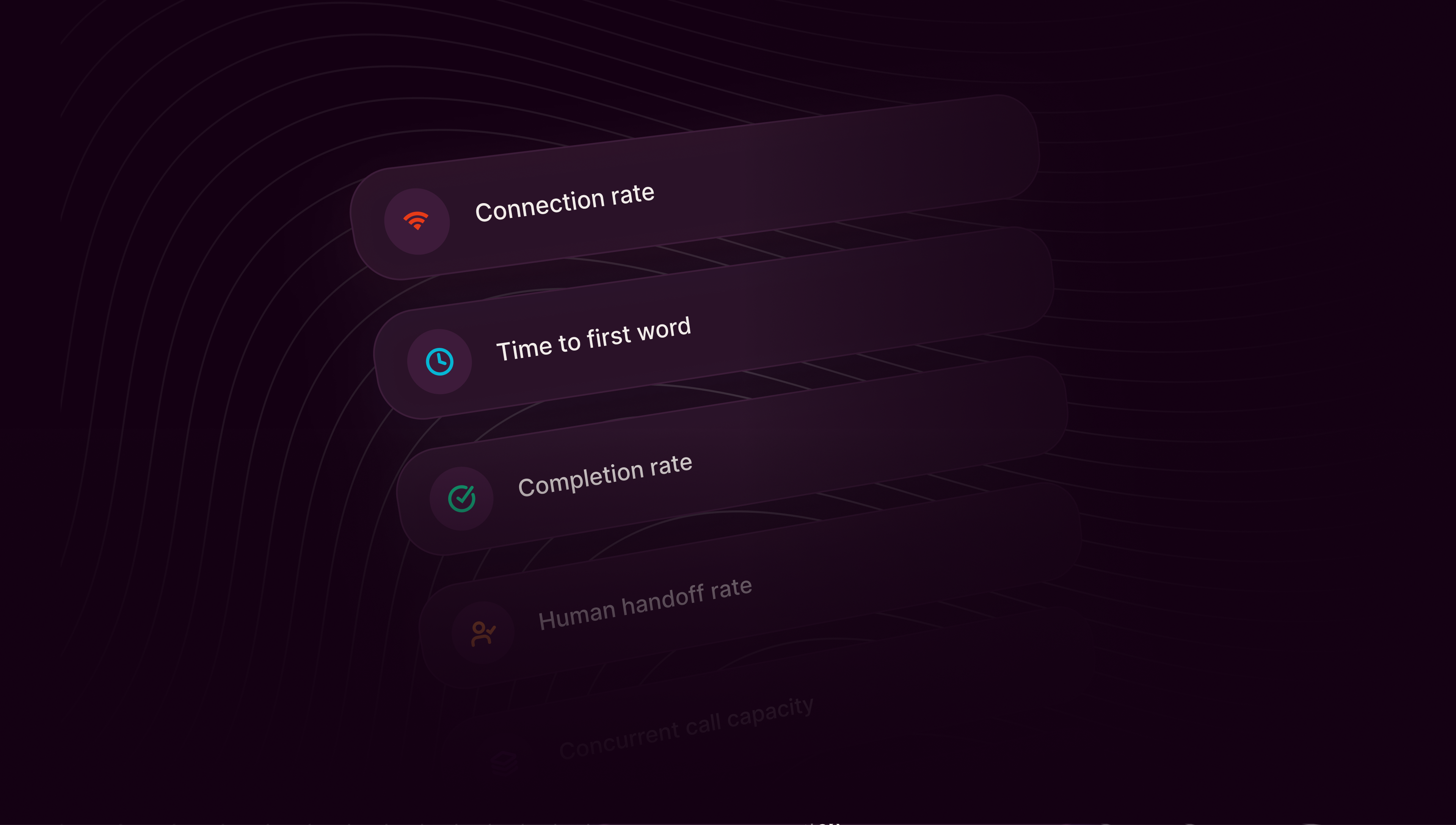
Most voice AI dashboards answer “did the agent sound good?” That is not the question. Here are the eight voice AI metrics we watch when a HeyBreez customer takes a workflow live, and what each one tells you about the operation.
A support lead we work with opened her voice AI dashboard on a Monday and saw a wall of green. Sentiment: positive. Transcription accuracy: high. Voice quality: excellent. Call volume: on target.
Forty-one appointments from Friday were missing from the calendar.
Every number on that dashboard was true. Not one of them measured the operation. The agent had talked well and the business had not gotten what it paid for.
This is the most common failure in voice AI measurement, and it is a measurement failure before it is a technology one. Voice AI moves outcomes across a business, not just words across a phone line. The metrics that matter measure whether those outcomes happened.
Voice AI metrics vs contact center KPIs
If you came from a contact center, you already have a KPI vocabulary: average handle time, first call resolution, abandonment rate, containment rate. Those metrics were built for a floor of human agents, and three of the assumptions behind them break with voice AI.
Handle time stops being a cost proxy. On a human floor, a shorter call is a cheaper call, because you are paying for minutes of a person’s attention. An AI agent’s cost is dominated by model tokens and telephony, so a call that is 30 seconds longer and actually closes is the cheaper outcome. Optimizing for handle time on voice AI optimizes for hanging up.
Containment stops being a good thing on its own. A contained call in IVR terms is a call that never reached a person. A voice AI agent can contain a call it had no business containing, which converts a two-minute transfer into a lost customer.
Resolution stops being observable inside the call. First call resolution assumed a human who logged the outcome. When the agent hangs up and the CRM update never fires, nothing in the call transcript tells you that. The failure happens after the audio ends.
So the eight KPIs below keep what still works from that vocabulary and replace what does not. They are ordered the way a call moves: does it connect, does it feel right, does it finish, does the work after it finish too.
The 8 voice AI KPIs at a glance
- Connection rate. Did the call establish a stable audio stream?
- Time to first word. How long does the caller wait before the agent speaks?
- Completion rate. Did the call reach its intended endpoint?
- Human handoff rate. How often does a person have to take over?
- Concurrent call capacity. How many live calls can you hold at once?
- Post-call task completion. Did the downstream work actually fire?
- Cost per successful outcome. What does one closed outcome cost, all in?
- Retry recovery rate. How many failed calls do you win back on a second attempt?
1. Connection rate
Connection rate is the percentage of dialed or answered calls that establish a stable audio stream. Divide calls with usable two-way audio by calls attempted.
It sounds trivial. It is not. Telephony routing, SIP negotiation, carrier quality, and provider concurrency limits all pull against this number, and they pull at different times of day.
Connection rate is the metric to read first, because it is the one that corrupts every other metric on the page. If it slips from 96 percent to 88 percent, your completion rate falls too, and you will spend a week rewriting a prompt that was never the problem.
We treat 95 percent and up as healthy. Below that, look at the infrastructure before you look at the agent.
2. Time to first word
Time to first word is the number of milliseconds between the caller finishing their sentence and the agent starting its reply. It is the latency metric a caller actually experiences, and it is not the same as model response time.
Past roughly half a second, the gap reads as a pause. Past a second, it reads as a bad line, and callers start talking over the agent to check whether anyone is there. Older pipelines that hand audio from speech to text, then to a model, then to text to speech, stack a delay at every step. Speech-to-speech models collapse most of that.
Track the median and the 95th percentile together. The average hides the tail, and the tail is where callers hang up. If your median looks fine and your p95 is three seconds, one call in twenty sounds broken.
3. Completion rate
Completion rate is the share of calls that reach the intended endpoint of the workflow. The endpoint is defined per workflow, not globally: the appointment on the calendar, the confirmed data point, the ticket closed or transferred cleanly.
This is where “did the agent talk well” becomes “did the operation deliver,” and it is the single most useful number on the list.
A completion rate of 40 percent is not a verdict, it is a pointer. It might be the instructions. It might be a branch the workflow never had. It might be a path the agent takes correctly and that dead-ends in a system that was never wired up. You cannot tell from the number, which is why completion rate is only useful if you can open the calls behind it and see where they stopped.
4. Human handoff rate
Human handoff rate is the percentage of calls transferred to a person. It is a design metric, not a failure metric, and it is the one teams most often read backwards.
A handoff rate of zero usually means the agent is improvising on calls it cannot handle. A handoff rate of 40 percent usually means the workflow is too shallow for what people are calling about. Neither number is good or bad without the workflow’s intent next to it.
Set the target deliberately. High-volume outbound qualification should sit low. Complex inbound support should sit healthy, because the transfer is the product working. Then read the number against the target you set, not against zero.
5. Concurrent call capacity
Concurrent call capacity is the maximum number of live calls the platform holds at once without degradation. Note “without degradation”: a provider that accepts the calls and adds a second of latency to each has not given you the capacity.
Capacity is a planning metric, so track peak concurrency next to daily volume rather than on its own. A campaign dialing 10,000 calls a day does not spread them evenly, and the ceiling that matters is the one you hit at 10am, not the daily average.
One of our customers runs roughly that volume in campaign dialing on HeyBreez, and the capacity math has to hold every hour of every day for the operation to work. If you are routinely hitting your ceiling, that is a scaling conversation with your vendor, not a performance problem with your agent. It is also one of the questions worth asking before you sign, because concurrency limits are rarely on the pricing page.
6. Post-call task completion
Post-call task completion is the percentage of calls where every downstream action fired successfully. The CRM record updated. The email sent. The booking slot marked. The callback scheduled. The ticket created.
Voice AI is not a chatbot with a phone number. The call ends and something else has to happen, and this is the KPI that separates a voice agent from a voice operation. If the call went perfectly and the CRM never got the update, the operation did not run. That is the Monday morning at the top of this post.
Most platforms leave this layer to you, which means the metric is not just unmeasured but unmeasurable: a webhook you fire into your own middleware reports its own success, not the outcome. HeyBreez builds the post-call layer into the workflow itself, with Path Steps that run in order, HTTP requests that push outcomes into your systems of record, and retries that catch the ones that fail. The number is only trackable if the platform owns the work it is counting.
7. Cost per successful outcome
Cost per successful outcome is your all-in voice spend divided by the number of calls that hit their intended outcome. Not cost per call, and not cost per minute. All-in means model tokens, telephony minutes, text-to-speech characters, and platform fees together.
Cost per call flatters a workflow that fails cheaply. A flow that costs half as much per call and closes a third as often is the more expensive flow, and only this metric shows it.
Track it per workflow rather than per platform. A high-reasoning inbound support flow and a light outbound verification flow have different cost profiles by design, and averaging them together hides the one that is drifting. This is also the number that moves when you change models, which is the practical argument for running different models on different workflows instead of one model everywhere.
8. Retry recovery rate
Retry recovery rate is the percentage of first-attempt failures that resolve on a later attempt. No answer, busy, voicemail, or a caller who asks you to call back this afternoon.
A no-answer that becomes a completed call two hours later is a saved outcome. A voicemail that triggers a follow-up message that closes the loop is a saved outcome. Retry recovery measures the operational muscle that most platforms hand back to the customer, and it compounds: at scale, the difference between retrying well and not retrying at all is a large share of the outcomes you paid to attempt.
If your platform does not handle retries natively, this KPI is not low. It is unmeasurable, and the outcomes are quietly gone. We wrote about that gap in more detail in Voice AI Vendors Are Selling Half a Product.
The meta-KPI: is the operation running?
Read the eight together, not as a checklist. They answer one question: is the voice operation doing the job the business hired it to do?
The wrong dashboard tells you the agent sounded good. The right one tells you the appointment got booked, the data got verified, the ticket got created, the follow-up got sent, and that all of it happened at the volume and the cost the business needs.
That is also the honest test of a platform. Six of these eight are only trackable if the platform owns the operational layer and not just the agent: completion end to end, handoff, concurrency at scale, post-call tasks, cost across model and telephony, and retries. If a vendor cannot show you those six from inside their own product, the dashboard you get will be the green wall.
Where HeyBreez fits
We built HeyBreez because the market solved the conversation and left the operation on the customer. The retries, the callbacks, the branching follow-up journeys, the post-call actions: all of it in one place, instrumented from the first call rather than reconstructed later from logs.
That is the difference between a voice agent and a voice operation. Between a demo that measures how the call sounded and production that measures what the call did. The workflows themselves are built by the people who run the operation, not only by engineers, which is a separate piece worth reading if that is your situation.
Frequently asked questions
What is a good connection rate for voice AI?
We treat 95 percent and above as healthy. Below that, the cause is almost always telephony, SIP configuration, or a provider concurrency limit rather than the agent, and every downstream metric becomes hard to read until it is fixed.
What is acceptable latency for an AI voice agent?
Measure time to first word, from the caller finishing their sentence to the agent starting to speak. Past roughly half a second it is audible as a pause, and past a second callers start talking over the agent. Track the 95th percentile as well as the median, because the tail is where calls are lost.
How do you measure voice AI ROI?
Use cost per successful outcome, not cost per call or cost per minute. Divide all-in voice spend, including model, telephony, and speech costs, by the number of calls that reached their intended endpoint. Calculate it per workflow, because different workflows have different cost profiles.
Are contact center KPIs still useful for voice AI?
Partly. Abandonment and transfer rates still translate. Average handle time does not, because AI cost is driven by tokens and minutes rather than by staff time, so a longer call that closes is often the cheaper one. Containment needs care too, since an agent can contain a call it should have transferred.
What is a good human handoff rate for a voice AI agent?
There is no universal number, and zero is a warning sign rather than a goal. Set the target from the workflow’s purpose: low for high-volume outbound qualification, healthy for complex inbound support where the transfer is the point. Then measure against that target.
Which voice AI metrics require platform support to track?
Six of the eight. End-to-end completion, handoff rate, concurrency at scale, post-call task completion, all-in cost per outcome, and retry recovery all depend on the platform owning the work after the call ends. Connection rate and latency can be measured at the telephony layer alone.
Start measuring the operation
If you want to see these eight numbers against your own call flow rather than a demo, get in touch and we will walk through the workflow you are trying to run.