Voice AI in Healthcare: 3 Use Cases That Actually Work
 HeybreezAI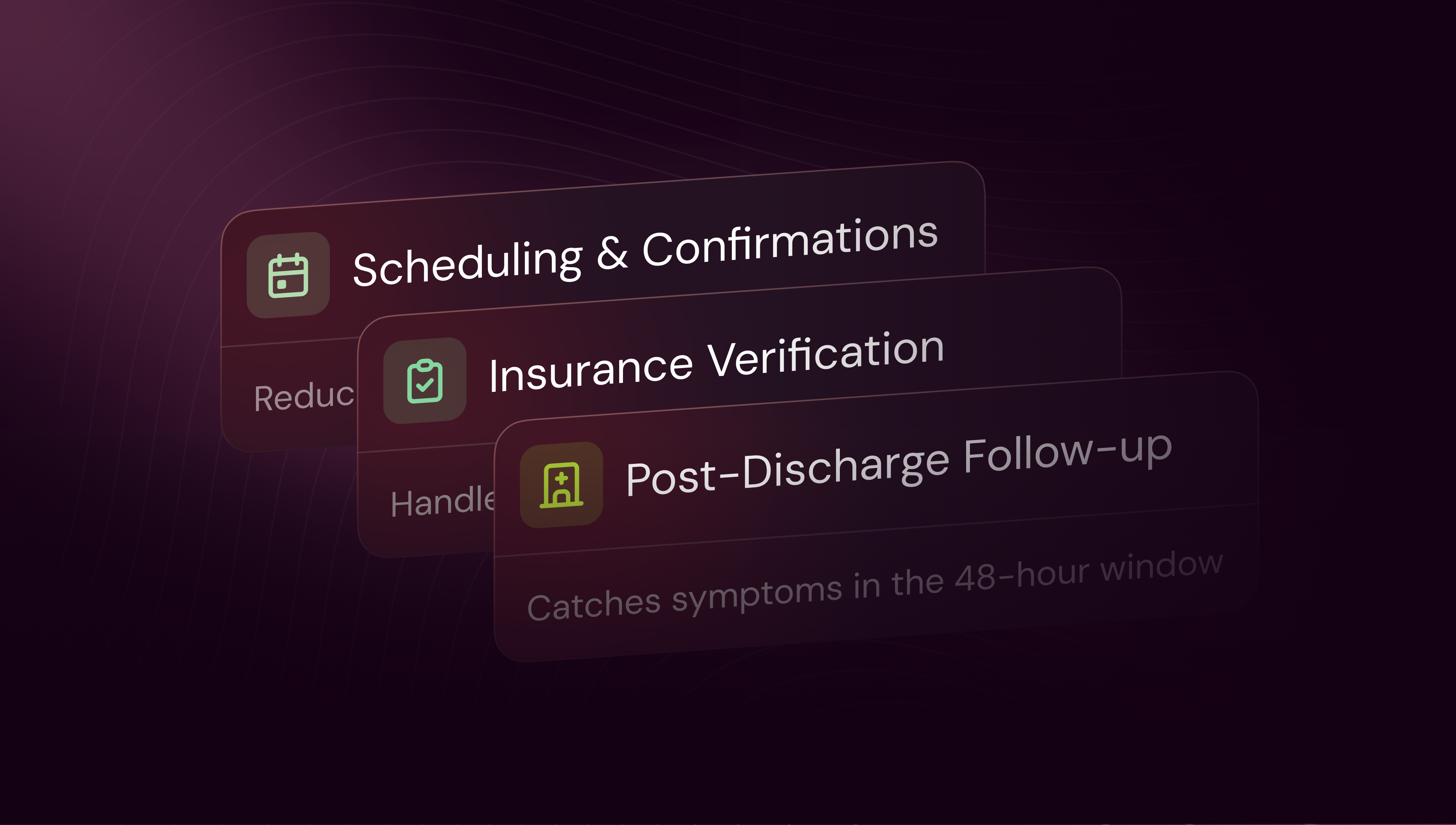
TL;DR: Three voice AI use cases in healthcare have crossed from pilot to production: appointment reminders that can rebook on the call, insurance verification and prior authorization, and post-discharge follow-up. All three are administrative, not clinical. None of them needs a new clinical protocol or a regulator’s sign-off. What decides whether they work is not the quality of the conversation. It is the operational layer around it: the retries, the callbacks, the escalations, and the write back into the EHR.
It is 4:40pm. A scheduler at a twelve-provider orthopedic group has ninety-one appointments on tomorrow’s book and a list of forty-three patients who did not reply to the reminder text. She has twenty minutes and no realistic way to call them. Tomorrow, roughly a dozen of those slots will sit empty. The clinic will still pay for the room, the provider, and the staff.
That is the actual shape of voice AI in healthcare today. Not diagnosis. Not drug discovery. The phone.
Why voice AI in healthcare is a different story from “AI will transform healthcare”
Healthcare has been about to be transformed by AI for a decade. Diagnostic imaging. Drug discovery. Clinical decision support. The headlines keep coming and the pilots keep piloting, because clinical AI moves at the speed a regulator and a five-year outcomes study can absorb it.
Administrative voice AI is not on that clock. It is not waiting on a regulator. It is not waiting on an outcomes study. It touches scheduling systems, insurer phone lines, and patient reminders, and it makes no clinical claim, so it needs no clinical approval. That is the entire reason it shipped first. It is already deployed. It is already working. Just not in the places the futurist decks talk about.
The market has noticed. Search for voice AI healthcare use cases and you will find lists of eleven, thirteen, and twenty-two of them. Most of those lists are inventories of what is technically possible. This is a shorter list. Three use cases have crossed the line from pilot to production. They are boring. They also pay for themselves within a quarter, because each one has a hard dollar attached that a CFO already tracks.
Use case 1: appointment reminders that can actually rebook the patient
The no-show is the oldest problem in outpatient care. Depending on specialty, no-show rates run fifteen to thirty percent. Published figures put the national average near 18%, with outpatient settings specifically running roughly 23% to 33% by specialty and population. Every empty slot is roughly one to three hundred dollars of provider time, and the commonly cited average cost of a missed appointment is around $200. Multiply by a mid-sized clinic network and the annual cost sits in the eight figures.
The received wisdom is to send more text reminders. Text reminders help. They also plateau. The patients who respond to text already respond to text. The remaining no-shows are the patients who do not read texts, do not open the portal, or need a real conversation to reschedule.
The trial evidence supports exactly that reading. A randomized study of 6,450 patients in an academic primary care clinic found text and telephone reminders produced statistically similar missed-appointment rates, 11.7% versus 10.2%. Read carelessly, that says voice adds nothing. Read properly, it says a voice agent that only reads a reminder out loud is a more expensive SMS. That is not the use case.
What the workflow actually looks like
The use case is the conversation a text cannot have. Forty-eight hours before the appointment, the agent calls. It confirms the patient and the appointment. If the answer is yes, it logs the confirmation to the EHR and moves on. If the answer is no, it offers three replacement slots pulled live from the scheduling system, books whichever the patient picks, and sends the confirmation text automatically. If the patient asks a question the agent cannot answer, it warm-transfers to a scheduler with the context attached. If nobody picks up, the operation retries at a smarter time, based on when that patient has answered before.
The published results from operators running this in production sit around a thirty to forty percent reduction in no-shows on the segment that never responded to text. That is not the full patient base. That is the segment nobody was reaching.
The value is in the second branch. A reminder text tells a patient they are about to miss an appointment. It cannot fill the slot. A call that ends with a rebooked patient converts a no-show into revenue inside one interaction.
Voice works here because the alternative is not chat. The alternative is silence.
Use case 2: insurance verification and prior authorization calls
The insurance phone tree is the hidden operational cost of every clinic. A single prior authorization can eat forty-five minutes of a staff member’s time on hold, most of it waiting. The industry estimate is that administrative work absorbs roughly a quarter of every provider dollar. A meaningful slice of that quarter is people on hold with insurers.
The measured figures point the same way. The American Medical Association’s 2025 prior authorization survey found physicians complete about 40 prior authorizations a week, consuming roughly 13 hours of physician and staff time. Two in five practices employ someone who does nothing else. And 94% of physicians say prior authorization contributes to burnout. Zoom out to the whole system and administrative complexity is the largest single category of waste in the JAMA waste analysis, at an estimated $266 billion a year.
Voice AI does not care about hold time. It can wait. It can also parse the insurer’s menu tree, answer the standard verification questions, capture the authorization number, and log the outcome to the record.
The hard part is not the conversation. The hard part is the persistence:
- The follow-up call the next day, because the case is still pending.
- The retry, because the fax number the insurer asked for did not go through.
- The escalation to a human, because the insurer denied the code and someone needs to file the appeal.
- The integration back into the EHR, so the next person who touches the chart sees the authorization number and not a sticky note.
This is where the operational layer earns its keep. Every one of those is a small piece of code. All of them together are the reason the ROI shows up in the first quarter. A voice agent that can talk to an insurer is impressive in a demo. A voice operation that runs the workflow around it is what actually removes hours from staff schedules.
Use case 3: post-discharge follow-up calls
The forty-eight-hour window after discharge is the most valuable readmission-avoidance window in the system. A short conversation in that window catches missed medications, misunderstood instructions, and early symptom escalation. Every catch that avoids a readmission is worth thousands of dollars and a much better outcome for the patient.
This is not a hunch. AHRQ’s Re-Engineered Discharge (RED) toolkit specifies the follow-up call at 48 to 72 hours, to review medications, appointments, and what to do if a non-emergent problem appears. AHRQ reports that RED prevented one readmission or emergency department visit for every seven patients who received it, cut hospital utilization by about 30%, and left patients costing $412 less in the 30 days after discharge. Against an average 30-day readmission cost of roughly $15,200 in AHRQ HCUP data, the arithmetic is not subtle.
Every hospital knows this. Almost no hospital does it well. There are not enough discharge nurses to reach every patient in the window, and the ones they do reach are the easy ones. The patients most likely to be readmitted are the ones least likely to answer a call from an unknown number, or least likely to admit that they missed a dose.
What the workflow actually looks like
Within forty-eight hours of discharge, the agent calls. It verifies identity. It asks the three or four questions tuned to that patient’s condition. For a post-cardiac patient, questions are about weight change, shortness of breath, and medication adherence. For a post-surgical patient, they are about incision site, pain level, and mobility. The agent listens for specific triggers. If it hears any of them, the call escalates to a clinician in the same session, not a callback four hours later.
This is the use case where voice does not replace a person. It reorders the queue so the person spends time on the calls that actually matter.
The three side by side
| Use case | Direction | What it is worth | The hard part |
|---|---|---|---|
| Reminders and rebooking | Outbound | Recovered slots at $100 to $300 each, against a 15% to 30% no-show rate | Live calendar write, warm transfer, smart retries |
| Verification and prior auth | Outbound | Staff hours against a 13-hour weekly prior auth burden | Persistence: callbacks, retries, appeal escalation |
| Post-discharge follow-up | Outbound | Avoided readmissions at roughly $15,200 each | Real-time clinical escalation inside the call |
What ties the three together
None of these use cases is glamorous. None of them is AI diagnosing anything. All three share the same shape.
The value is not in the conversation. The value is in the operation around the conversation. Reaching the right person at the right time. Retrying when the first attempt failed. Escalating when the situation warrants a human. Feeding the outcome back into the system of record so the next call starts from what the last one learned.
This is the reason voice AI in healthcare tends to fail on generic platforms. The conversation half is well understood. The operational half is not. We wrote about that gap in voice AI vendors are selling half a product.
Getting the schedule reminder call to actually connect, the prior auth workflow to actually persist, and the discharge escalation to actually route is where the operational layer decides whether the technology is a demo or a running system. If you are evaluating vendors right now, our buyer’s checklist covers the questions that surface this before you sign, and the metrics worth tracking covers how to tell afterwards.
Where Heybreez fits
We built Heybreez as the operational layer for Voice AI. HIPAA-ready. Built for the callbacks, the retries, the escalations, and the integrations that healthcare workflows depend on. Deploy in days, not months. You own the workflow, not a vendor ticket.
A customer at Zain Jordan built a working demo in two hours. A UK customer runs about five thousand calls a day in production. The same infrastructure a health system needs. Reliable, concurrent, and built for what happens after the call.
On compliance, treat any vendor claim as a starting point and get the detail in writing. Ask who signs the BAA, where audio and transcripts are stored, how long they are retained, whether recordings train anyone’s model, and which subprocessors touch PHI. If a vendor cannot answer those five questions, the demo does not matter.
Frequently asked questions
Is voice AI in healthcare HIPAA compliant?
HIPAA compliance is a property of a deployment, not of a technology. A voice AI system can be operated in a HIPAA-compliant way when the vendor signs a Business Associate Agreement, PHI is encrypted in transit and at rest, retention is bounded and documented, and every subprocessor that touches audio or transcripts is covered. Ask for that in writing before a pilot handles a single real patient.
What is the best first voice AI use case for a clinic?
Appointment reminders with live rebooking. The workflow is bounded, the failure mode is mild, the integration surface is one scheduling system, and the return is measurable in a single billing cycle. Prior authorization is the larger prize, but it involves more systems and more edge cases, so it is a better second project than a first one.
Does a voice agent beat text reminders at reducing no-shows?
Not at the reminder itself. Randomized evidence puts phone and text reminders at broadly similar missed-appointment rates across a general patient population. Voice wins on the actions text cannot take: rebooking the patient inside the same interaction, reaching the patients who never respond to text at all, and handing off to a human when the patient has a question. Operators running the full rebooking workflow report thirty to forty percent fewer no-shows in that non-responding segment.
How long does a healthcare voice AI deployment take?
The conversation is not the schedule driver. Integration and escalation design are. A single bounded workflow against one system, such as reminders and rebooking, is a matter of days. Prior authorization across multiple payers takes longer, because each payer’s process is its own edge case.
Will voice AI replace medical schedulers and discharge nurses?
In these three use cases it does not. It absorbs the calls with a predictable script and no clinical judgment, and it escalates everything else. The effect is that staff spend their time on the calls where a human changes the outcome.
The close
The AI-will-transform-healthcare story is still years out. Diagnostic AI is genuinely coming, but it will keep moving at the speed regulators can absorb it.
The AI-will-handle-the-phones story is already here. It has been in production for two years. It is measurable, it pays for itself in a quarter, and it does not need a single new clinical protocol to work.
Start with the phones. The rest will come. If you want to see one of these three workflows running against your own systems, talk to us.
Sources
- AMA, 2025 Prior Authorization Physician Survey
- AHRQ, Re-Engineered Discharge Toolkit, Tool 5: post-discharge follow-up calls
- AHRQ, Hospital Admission Versus Readmission Costs
- Junod Perron et al., text-message versus telephone reminders, randomized controlled trial
- JAMA waste in US health care analysis, administrative complexity estimate