Voice wins where the workflow needs a conversation, not just a message
 HeybreezAI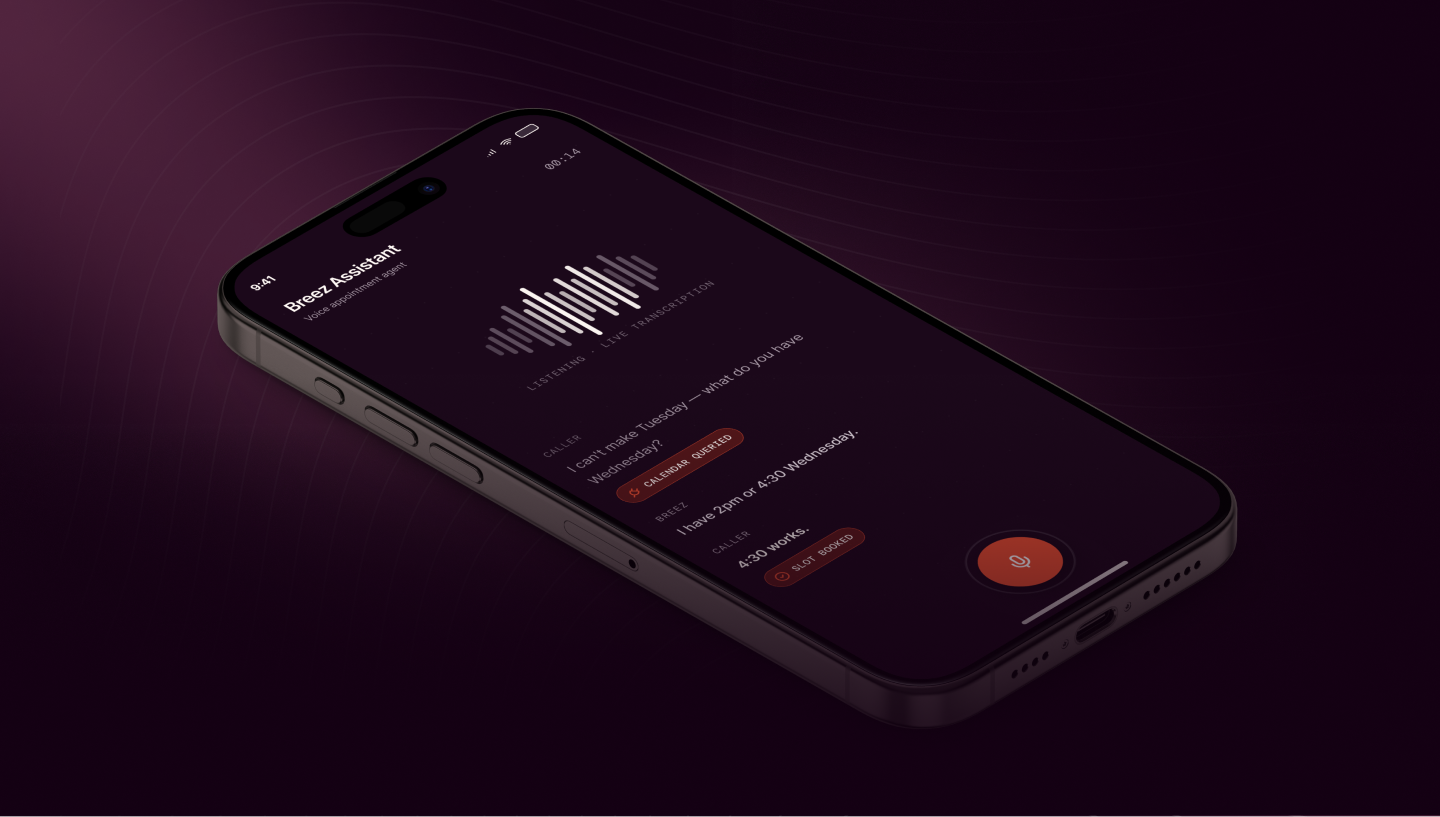
Is voice AI better than email, SMS or chat? Only for some workflows. Voice AI wins when the customer has to explain something, the next question depends on their answer, or the business has to start the conversation and act on it before the call ends. For a simple reminder, a text message is cheaper and works almost as well. Heybreez is a voice AI platform built for the first kind of work, with agents that speak regional dialects and pull structured data from every call, and an operation that keeps going after the conversation ends through automatic retries and callback scheduling.
Most channel debates start in the wrong place. They compare open rates with answer rates, message costs with call costs, and conclude that whichever number looks better should own the customer. That comparison does not survive contact with an actual operation, because the numbers describe different behaviours and none of them describe a finished piece of work.
Start instead with the workflow. A Cochrane review of eight randomised trials covering 6,615 participants found attendance of 67.8 percent with no reminder, 78.6 percent with a mobile message and 80.3 percent with a telephone reminder, pooled across the trials. Where SMS and phone were tested head to head, attendance was statistically similar, and two studies found text reminders cost 55 and 65 percent less per attendance than phone calls. If the job is to remind someone about a confirmed appointment, a text message is very hard to beat, and any vendor telling you otherwise is selling you something.
The economics change the moment the reminder has to become a conversation.
“I cannot make Tuesday, what do you have Wednesday afternoon?”
“I am not ready to pay the full balance, but I can pay half on Friday.”
“The installation is blocked because IT has not approved SSO.”
“Before I renew, explain the price increase.”
Every one of those replies breaks a static message. The customer now has a new step to take, in a different place, at a later time, with a lower chance of completing it. A voice agent that can hear the answer, ask the follow up, query a live system, execute the change and confirm it before hanging up does not add a step. It removes the remaining ones.
That is the argument. Not a better way to send a message. A better way to finish work.
Why does voice AI beat email, SMS and chat? Seven reasons it wins when it wins
1. It compresses the workflow
A reschedule by email runs: message sent, noticed, opened, understood, link clicked, authenticated, availability checked, slot chosen, submitted, confirmation awaited. Ten steps, each one a place to drop out. A voice workflow runs: call answered, reason explained, customer responds, agent clarifies, calendar queried, alternative offered, customer confirms, calendar updated, written confirmation sent. Same outcome, one continuous interaction, and the system of record is already updated when the call ends.
2. It removes input friction
A Stanford led study of mobile text entry, published in 2018, found speech input 2.93 times faster than typing in English and 2.87 times faster in Mandarin. That was a speech to text experiment, not a contact centre trial, so it does not mean a voice workflow is three times faster end to end. It does explain why asking someone to say an address, a reason, a date or an objection is far less costly than asking them to type it into a form.
3. The next question can depend on the last answer
Asynchronous channels turn clarification into a queue. Every “which account do you mean?” costs another message, another wait, another chance to be ignored. Synchronous dialogue collapses that loop to nothing. This is the single largest structural advantage voice holds over email and SMS, and it grows with the number of branches in the workflow.
4. Tone carries information that text strips out
In experiments by Schroeder, Kardas and Epley, people who heard someone explain a position rated that communicator as more mentally capable and more human than people who read the identical words, and the effect showed up most clearly when the listener disagreed with them. Earlier work by Schroeder and Epley found that removing naturalistic variation in pace and intonation eliminated the humanising advantage. A 2025 experiment led by University of Amsterdam researchers, with 212 participants, found that a synthetic voice agent whose prosody was aligned to the user’s information state was more persuasive than a text agent, producing more positive brand attitudes, mediated by perceived human likeness and personalisation.
Read that carefully. The finding is not that speech beats text. It is that well designed speech beats text. A preregistered study with 450 participants found the opposite result for the voice agents it tested: more human like ratings for text, and higher cognitive load for voice. Poor voice AI is worse than a good chatbot.
5. It can start the conversation
A chatbot waits. Text AI is extremely good at what it does, and the results are real: Klarna reported its assistant handling two thirds of service chats in its first month. But almost all of that value is inbound. It requires a customer who has already decided to open a session. Voice is the only channel that can start a live, real time conversation with a customer who was not planning to talk to you today, which is exactly the population that stalled onboarding, quiet renewals and overdue balances are made of.
6. The conversation can execute, not just inform
This is the part most comparisons miss. A voice workflow that can make function calls during the call, book the slot, take the payment, update the CRM, write the structured outcome back and trigger the follow up is not a channel. It is a workflow engine where conversation happens to be the interface. Conversation plus execution is the product. Speech on its own is a feature.
7. It degrades gracefully
When automation reaches its limit, a well built voice workflow transfers to a person with the full context attached, so the customer does not start again. When the call is not answered, it retries, schedules a callback, or falls back to text. The promise worth making is not that AI resolves everything. It is that AI resolves what it can and hands over the rest without losing the work already done.
When should you use SMS, email or text AI instead of voice?
A routing policy is worth more than a channel preference. The question is never “voice or SMS.” It is “at which point in this workflow does a real time conversation materially change the probability of completion.”
| Workflow | Default modality | Where voice earns its cost |
|---|---|---|
| Appointment reminders | SMS. The evidence is clear and voice should not fight it. | High value appointments, prior no shows, no response to the text, anything that needs rescheduling or pre qualification. |
| Onboarding | Email for documents, instructions and low touch setup. | Stalled accounts where the business does not know why. Voice diagnoses the blocker, captures the missing contact, books the technical session. |
| Surveys and feedback | Email or SMS for cheap structured scores. | Detractors and ambiguous answers. A 6 out of 10 in a text survey is data. A spoken answer to “what would you have wanted instead” is a reason you can act on. |
| Collections | Written notice and a self service payment link first. | Unresolved and high value accounts. Objection handling, part payment negotiation, promise to pay capture, all with written confirmation after. |
| Customer support | Text AI for FAQ, links, screenshots, config values, code. | Urgent, ambiguous, emotionally charged or hands free situations, multi step troubleshooting, and customers who are already calling you. |
In customer support in particular, the competitor is not email. It is text AI, and it is good. Use text when the customer benefits from seeing something: a URL, a table, a configuration value, a transcript they can search later. Use voice when the customer benefits from explaining a problem in their own words, being guided while their hands are busy, interrupting to ask a follow up, or getting to a human without repeating themselves.
How do you compare voice AI with email and SMS fairly? Stop comparing open rates with answer rates
Email opens are inferred from tracking pixels, and Mailchimp itself warns that Apple Mail Privacy Protection can inflate them. Its benchmark data, last updated in December 2023, reports a 35.63 percent average open rate and a 2.62 percent click rate. Those are upper funnel signals, not completed business outcomes. Putting them beside a call answer rate on the same chart is marketing, not analysis.
Give each channel its own funnel and compare only the last stage. For the voice side, our eight KPIs every voice operation should track cover the stages in more depth.
- Voice: attempted › rang › answered › disclosure completed › meaningful conversation › qualified intent › workflow completed › outcome retained
- SMS: delivered › read or replied › workflow started › workflow completed
- Text AI: session initiated › meaningful engagement › automation attempted › resolved › no repeat contact
The one metric that makes channels honestly comparable is cost per successful interaction: all in operational cost divided by verified completed workflows. For voice the numerator has to include telephony, recognition and synthesis, model inference, platform fees, integration amortisation, monitoring, failed calls and human escalations. For SMS and email it has to include the messaging cost plus the labour and follow up contacts required when the first message does not finish the job. A cheap message that does not complete the work is not cheap.
That framing also sets the bar for evidence. Published evidence is most useful for its limits, and the limits matter if you want a business case that survives a CFO.
| Evidence | Result | What it does not prove |
|---|---|---|
| Cochrane reminder review | Attendance 67.8 percent none, 78.6 percent SMS, 80.3 percent phone, pooled across trials. SMS and phone similar head to head | It does not evaluate conversational voice AI that can reschedule during the call. |
| Gallup survey experiment | Phone response 38 to 41 percent against 11 to 13 percent for SMS variants | It is survey methodology, not an AI trial. In a separate panel test without phone, Gallup’s best combined result paired email with text reminders, and it judged text not ready as the only contact mode. |
| Leroy and Kauchak | Comprehension 55 percent audio against 53 percent text, retention better for text | It shows voice has a memory weakness that written follow up has to cover. |
The cleanest way to settle the argument inside your own business is a randomised test at customer level: same eligible population, same objective, same contact window, same attempt cap, same escalation policy, incumbent workflow against voice workflow. Set the primary endpoint to the business outcome rather than channel engagement. Attendance for reminders. Cash collected or kept promises for collections. Activation within seven days for onboarding. Verified resolution without repeat contact for support.
Analyse it on an intent to treat basis. Everyone randomised to voice stays in the voice cohort even if they never answer. Reporting completion among answered calls only removes voice’s biggest weakness from the result and will flatter the pilot into a decision you regret at scale.
The second experiment is more valuable than the first. Run voice first and text first, each with and without a fallback to the other. That does not tell you whether voice beats SMS. It tells you the right orchestration order. In plenty of businesses the winning sequence is SMS first and voice second, and that is not a defeat. It means voice is being spent where its marginal value is highest instead of where a cheaper channel already works.
What changes when your customers speak Arabic?
Almost none of the evidence in this piece comes from Arabic speaking markets. In Arabic speaking markets the case for voice gets stronger in one way and harder in another, and both matter before you pick a channel.
It gets stronger because people speak in dialect. A customer in Riyadh, Abu Dhabi or Cairo talks to you in Najdi, Emirati or Egyptian Arabic, and often drops into English for a date, a name or an account number. A form or a chat window asks them to turn that into typed text first. On a call, they just say it. That is reason 2 above, input friction, and in a market where the spoken and written forms of a language differ, it carries even more weight.
It gets harder because the agent has to hear and answer in that dialect. The Almieyar benchmark tested 12 automatic speech recognition systems on 17 Arabic dialects in six families, using 13.7 hours of newly recorded speech, and no model performed uniformly best across all groups. The ArabCulture-Dialogue benchmark found that the strongest models can pick a culturally appropriate response yet struggle to write in a specified dialect when asked directly. A vendor that says it “supports Arabic” may mean Modern Standard Arabic, a formal written register that most callers do not use in everyday speech.
So the measurement rules in the previous section apply per dialect. Run the pilot separately for each dialect your callers actually use, on real telephone audio, and include calls where the caller switches to English mid sentence. Score the completed workflow, not how local the voice sounds. Our guide to evaluating Arabic dialect voice agents sets out the checks in detail.
Heybreez agents understand and speak a wide range of languages and regional dialects, with voices in Najdi, Hijazi, Emirati and Egyptian Arabic, for customers in the UAE, Saudi Arabia, Egypt, the UK and the US. Calls are routed between AI agents, departments and live human agents based on real-time context.
Four things that decide whether any of this survives contact with a customer
Latency is the product
An email that arrives 500 milliseconds later feels identical. A conversational agent that pauses at turn boundaries feels broken, because the silence happens inside a live social exchange. Monitor tail latency, tool call latency, interruption recovery, false end of turn detection and abandonment after slow responses, not just the average.
Compliance belongs in the state machine
Consent and purpose state, do not contact lists, permitted calling windows, jurisdiction, recording rules, authentication level, data access scope, retry limits and escalation thresholds should be machine enforced workflow variables. They should not be instructions a language model is expected to remember. Rules differ by market and by use case, and collections carries the tightest constraints of all.
Accessibility means multimodal, not voice
Voice removes visual and typing requirements, which helps many people a great deal. It is not automatically inclusive. W3C research on voice systems and conversational interfaces flags barriers for people with differences in memory, processing speed, auditory comprehension, attention and speech production, and recommends accessible error recovery and a reachable human. Every serious workflow needs “would you rather continue by text,” “I can send you those options,” and “let me put you through to someone.”
Always send the written summary
Text beat audio on retention in controlled testing. So use voice for understanding, clarification, negotiation and action, and use text for persistence, evidence, instructions and proof. After every call, send the appointment time, the payment commitment, the reference number, the checklist. That is not a concession to text. It is each medium doing what it is best at.
When does voice AI earn the workflow? When conversation changes the outcome
Email is excellent for durable, information dense communication. SMS is remarkably efficient for short notifications. Modern text AI resolves large volumes of digital support. Customer preference is genuinely mixed: in a Twilio survey of 3,900 consumers, 67 percent named email as a preferred support channel, 44 percent phone and 31 percent text.
So the test is narrow and worth applying honestly. Voice earns the workflow when one or more of these is true:
- The customer has to explain something the form cannot capture
- The next question depends on the previous answer
- Objections or hesitation decide the outcome
- The action has to happen before attention moves elsewhere
- The business needs to initiate, not wait
- The path has branches that only a diagnosis can resolve
- An external system has to change during the interaction
- A missed contact has to trigger recovery rather than end the attempt
- A human is sometimes necessary and the context has to survive the handover
When none of those hold, send the message. When several of them hold, a message is a step in a process that a conversation would have finished.
Frequently asked questions
Is voice AI better than SMS for appointment reminders?
Usually not on its own. In the Cochrane review, phone and SMS reminders produced statistically similar attendance, and SMS cost less. Voice earns its cost when the reminder turns into a conversation: the customer needs to reschedule, the appointment is high value, or the text went unanswered.
When should a business use voice AI instead of email or chat?
When the customer has to explain something a form cannot capture, the next question depends on their answer, objections decide the outcome, or the business has to start the conversation. If none of those hold, a message is cheaper and does the job.
How do you measure whether a voice AI pilot is working?
Use cost per successful interaction: all operating cost divided by verified completed workflows. Randomise at customer level, compare voice against the current workflow on the same population, and analyse everyone assigned to voice, including people who never answered.
Can an AI voice agent hand a call to a human?
A well built one should, with the context attached so the customer does not start again. Heybreez transfers calls between AI agents, departments or live human agents based on real-time context.
Does voice AI work in Arabic dialects?
It depends on the dialect and the system. A 2026 benchmark of 12 speech recognition systems across 17 Arabic dialects found no single system best on all of them, so test each dialect your callers use on real phone audio. Heybreez offers voices in Najdi, Hijazi, Emirati and Egyptian Arabic.
Should you still send a written follow up after a voice call?
Yes. In controlled testing, people retained information better from text than from audio. Use the call to understand, negotiate and act, then send the appointment time, payment commitment or reference number in writing.
Voice infrastructure, engineered to scale
Heybreez is the operational layer for voice AI: configurable workflows with live function calls into CRM, calendars and payments, retry and callback logic, contextual transfer to humans, structured outcome extraction, and post call analysis of transcripts, sentiment and results. Built so the conversation is where the work gets done, not where it gets scheduled.
We scope pilots around your own workflow, your systems and your definition of success, and agree how it will be measured before the first call. Book a strategy call.
Sources
- Gurol-Urganci et al., Mobile phone messaging reminders for attendance at healthcare appointments, Cochrane Database of Systematic Reviews, 2013. pubmed.ncbi.nlm.nih.gov/24310741
- Marlar, Using text messaging to reach survey respondents, Gallup, 2017. news.gallup.com/opinion/methodology/221159/using-text-messaging-reach-survey-respondents.aspx
- Ruan, Wobbrock, Liou, Ng and Landay, Comparing speech and keyboard text entry for short messages in two languages on touchscreen phones, Proc. ACM IMWUT, 2018. dl.acm.org/doi/10.1145/3161187
- Schroeder, Kardas and Epley, The humanizing voice, Psychological Science, 2017. pubmed.ncbi.nlm.nih.gov/29068763
- Schroeder and Epley, Mistaking minds and machines, Journal of Experimental Psychology: General, 2016. pubmed.ncbi.nlm.nih.gov/27513307
- Voorveld et al., Examining the persuasiveness of text and voice agents, Behaviour and Information Technology, 2025. doi.org/10.1080/0144929X.2024.2420871
- Ischen et al., Is voice really persuasive? Internet Research, 2022. doi.org/10.1108/INTR-03-2022-0160
- Leroy and Kauchak, A comparison of text versus audio for information comprehension, JAMIA Open, 2019. pubmed.ncbi.nlm.nih.gov/31294421
- Mailchimp, Email marketing benchmarks, data as of December 2023. mailchimp.com/resources/email-marketing-benchmarks
- Twilio, Consumer preferences report, 2024. www.twilio.com/en-us/blog/insights/cx/Meeting-customers-where-they-are-with-effective-support
- Klarna, AI assistant handles two thirds of customer service chats in its first month, 2024. www.klarna.com/international/press/klarna-ai-assistant-handles-two-thirds-of-customer-service-chats-in-its-first-month
- Almieyar: a culturally grounded benchmark for multi-dialect Arabic speech recognition, 2026. arxiv.org/html/2609.35564v1
- Cultural benchmarking of LLMs in standard and dialectal Arabic dialogues (ArabCulture-Dialogue), 2026. arxiv.org/html/2605.00119v1
- W3C, Cognitive accessibility research modules: voice systems and conversational interfaces, draft note, 2026. www.w3.org/TR/coga-voice
- US FTC, Telemarketing Sales Rule. www.ftc.gov/legal-library/browse/rules/telemarketing-sales-rule
- US CFPB, Debt Collection Rule FAQs. www.consumerfinance.gov/compliance/compliance-resources/other-applicable-requirements/debt-collection/debt-collection-rule-faqs
- Heybreez, homepage. heybreez.ai
- Heybreez, Features. heybreez.ai/features
Nothing here is legal advice. Communication rules vary by jurisdiction and use case and should be mapped before deployment.